Defining the compliance layer for an industrial AI safety monitoring platform.
Real-time monitoring dashboards mean nothing if the system can't survive an audit. I ran field research to define what compliance-ready actually looked like.
My research findings led to a strategic decision to discontinue the product.
ROLE
UX Research & Strategy
TIMELINE
4 months, 2021
Rapid Pivot
TEAM
6 people
SCOPE
MVP Prototype
DOMAIN
Enterprise SaaS
TOOLS
Figma
PROJECT OVERVIEW
A Safety Platform Built at Pandemic Speed
Alarta was an AI-powered COVID-19 safety and compliance platform, aimed to help facilities resume safe operations during the pandemic.
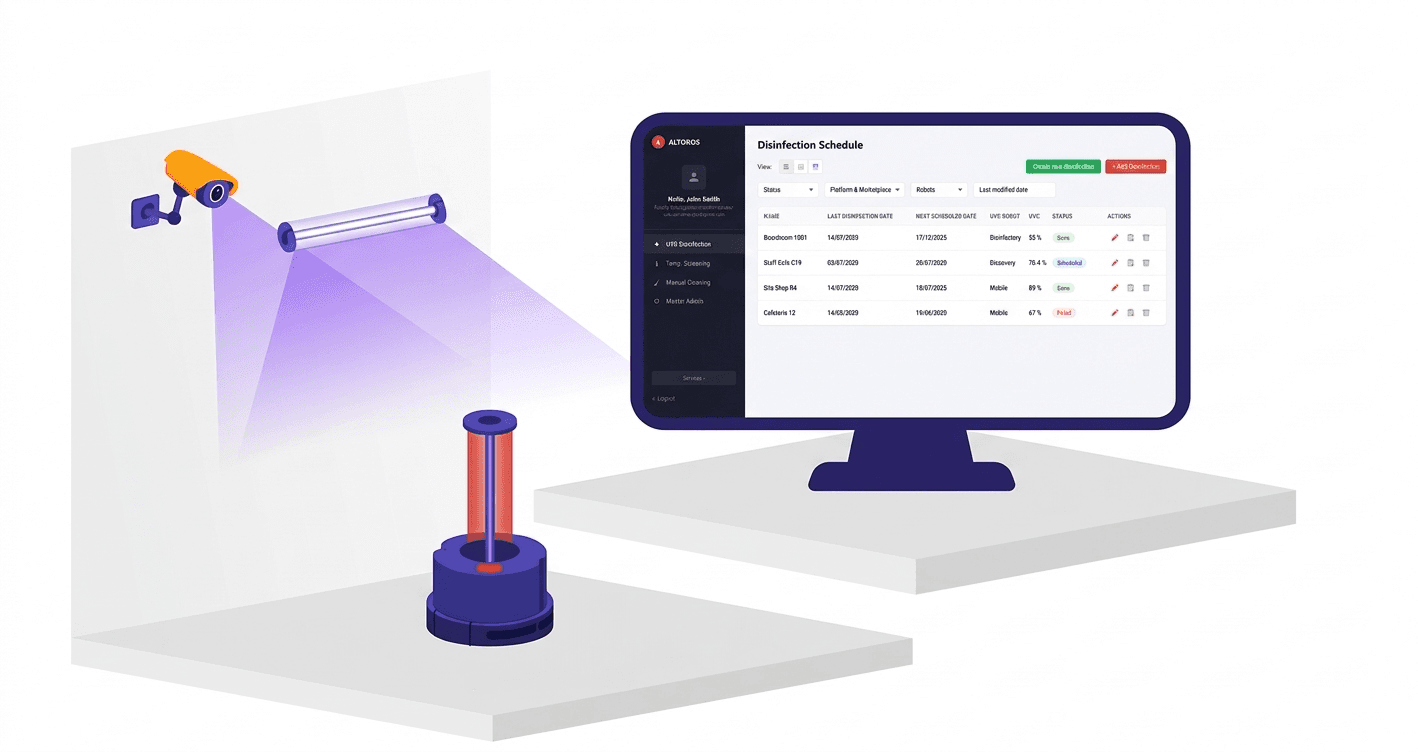
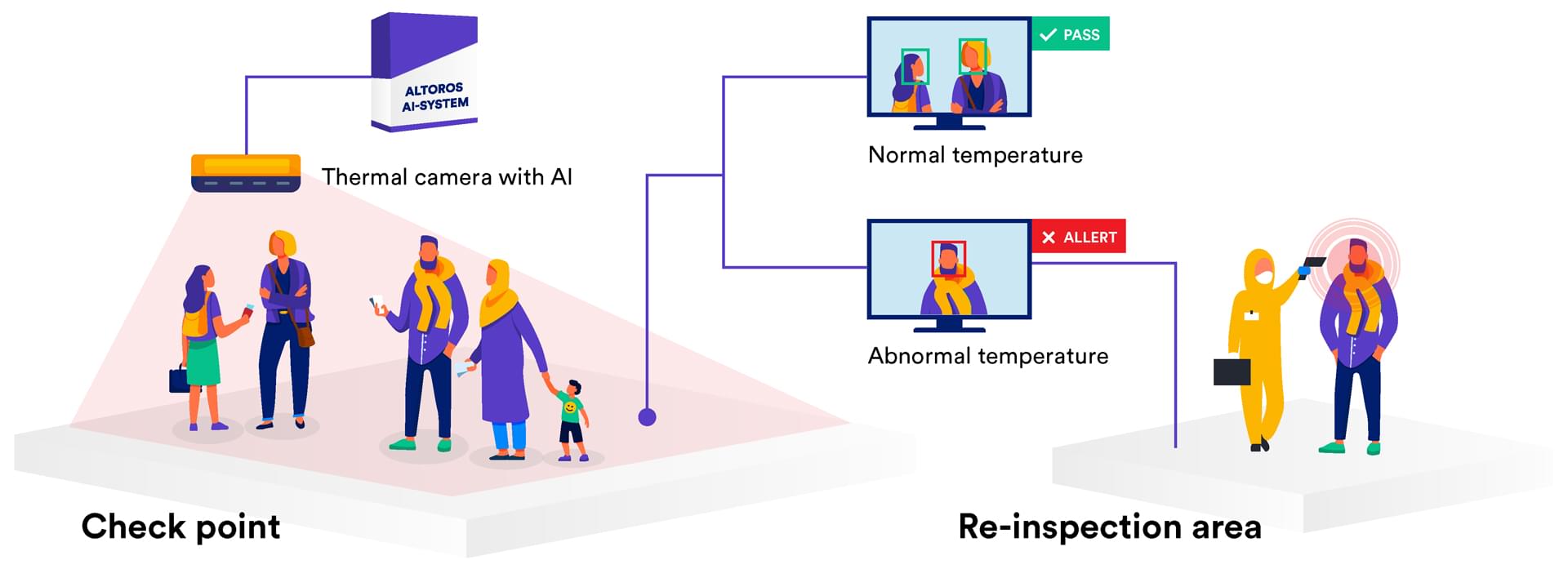
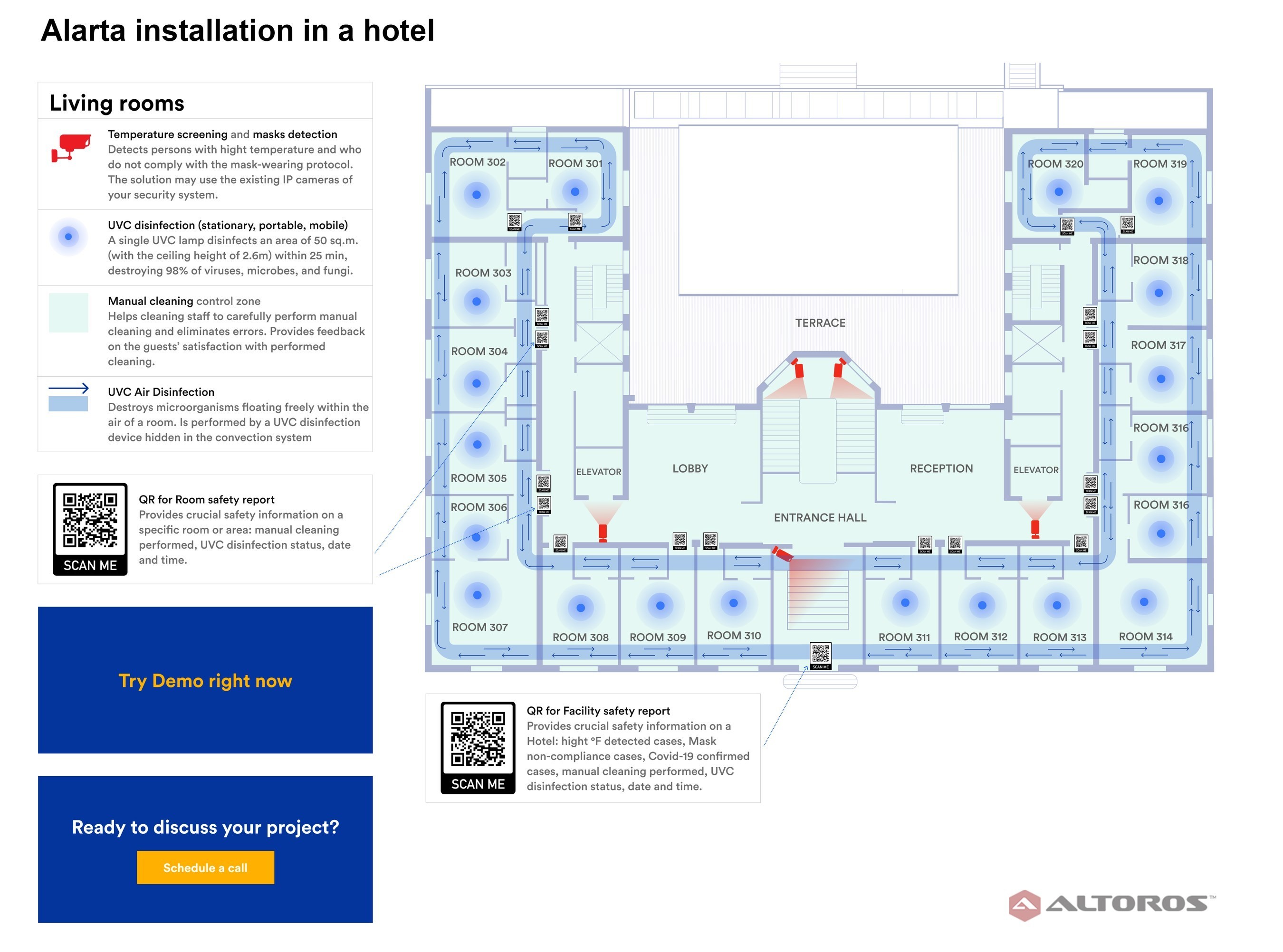
The platform offered five integrated modules: temperature screening with AI-driven thermal cameras, mask detection, UVC disinfection automation, manual cleaning management, and contact tracing. It targeted facility managers across hospitality, transportation, healthcare, retail, education, and entertainment — essentially any industry managing physical spaces with foot traffic.
Target Industries
- Hospitality and Tourism - Transportation - Healthcare - Education - Retail and Commercial - Entertainment and Sports
Five Integrated Modules
- Temperature screening with AI-driven thermal cameras - Mask detection - UVC disinfection automation - Manual cleaning management - Contact tracing
Brutal Competitive Landscape
Dozens of COVID safety solutions had emerged, from simple cleaning checklists to enterprise facility management platforms, all vying for the same anxious market.
THE PROBLEM
Demos Without Conversion
The team had been interpreting this as a messaging problem — potential customers just didn't understand the product well enough.
The platform had capabilities - thermal cameras could screen up to 30 people simultaneously with 95% accuracy, and the QR-code-based cleaning verification system was well-designed. But something fundamental wasn't connecting. My initial brief was to sharpen the value proposition and improve the demo experience. That assumption didn't survive first contact with actual facility managers.
MY ROLE, SCOPE & RESEARCH METHODOLOGY
Hired for Discovery. Saw Something Bigger.
Initial discovery work revealed something the team hadn't seen — businesses weren't ready to invest in simple automation.
I was brought on to define the strategy to unlock subscriber growth. I expanded my scope significantly beyond what was asked.
The team's existing outreach was generating almost no responses — cold LinkedIn messages focused on selling rather than learning. I redesigned the approach: personalized templates that led with genuine curiosity about compliance workflows rather than product pitches. Reply rate increased 6x.
Over the research period I initiated over 100 written conversations with facility managers and compliance officers across hospitality, healthcare, transportation, and logistics — recruited through LinkedIn and industry association forums, targeting people actively managing COVID compliance in operational facilities. The majority of insights came through written back-and-forth exchanges; seven participants agreed to follow-up interviews. I synthesized findings across both written and interview responses using affinity mapping, clustering responses around three recurring themes that became the design principles for the compliance layer.
Before pivoting the research direction, I presented my early findings to the team — the pattern from initial facility manager conversations was too consistent to ignore. The team agreed to expand the research scope before committing to any design work.
DISCOVERY
The Signal Nobody Was Hearing
Alarta was designed as an operations tool — automate and track cleaning. But facility managers needed a compliance tool — prove to regulators, insurers, and the public that requirements were being met.
In my early outreach to facility managers, I noticed a recurring pattern that the team had been interpreting as simple lack of interest.
Prospective customers weren't disinterested in the product's technical capabilities — they acknowledged the thermal cameras were impressive, the QR-based cleaning tracking was clever. But every conversation kept drifting to the same territory: their compliance burden. How do I prove to my regional inspector that we're meeting CDC guidelines? Can this generate the documentation I need for our insurance audit? Does this map to OSHA's updated requirements?
The product was answering a question nobody was asking ("How can I automate my safety processes?") while ignoring the question everyone was desperate to answer ("How can I prove I'm compliant?").
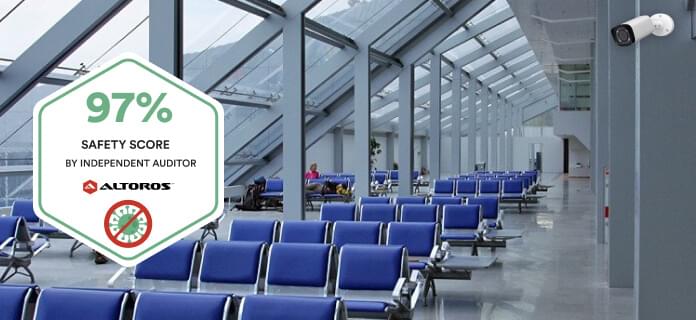
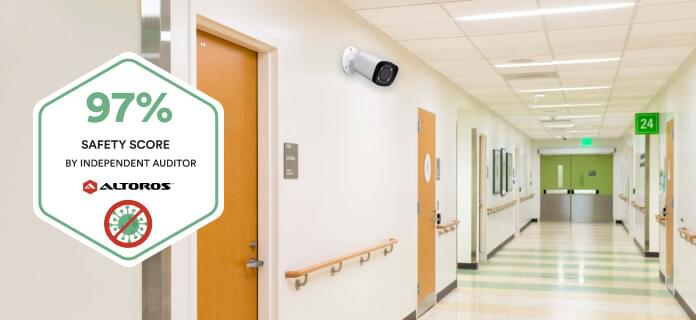
DEFINING SCOPE
Why I Focused on Manual Cleaning
"An inspector showed up without warning. I had nothing to show them." — Facility Manager.
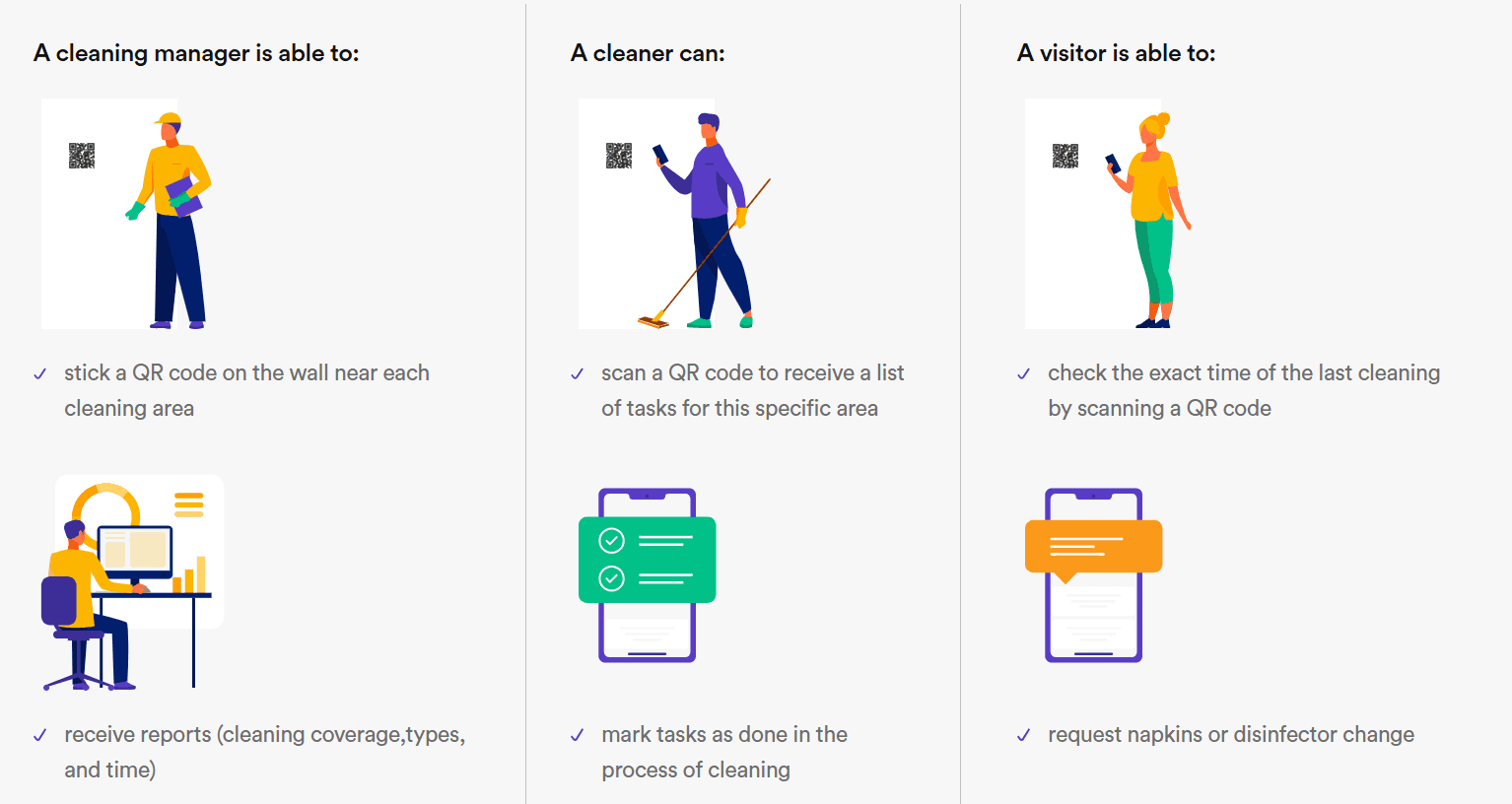
Thermal imaging largely ran itself. Manual cleaning compliance was where the human coordination gaps — and the liability risk — lived. With limited capacity, the team decided to test that assumption first.
Regulatory Pressure
CDC, OSHA, and local health departments had issued specific surface disinfection protocols. Facilities needed documented proof of adherence to remain operational. Thermal imaging had no equivalent documentation burden.
Legal & Insurance Liability
Facilities faced potential litigation if someone contracted COVID on-premises and they couldn't document their cleaning protocols. Insurance policies required cleaning compliance records.
Human Coordination Gap
Thermal imaging was already automated — set up cameras and the system runs. Manual cleaning required coordinating teams, tracking tasks, verifying quality, and maintaining audit-ready records. This was the biggest pain point.
UI AUDIT
A Dashboard That Tracked Activity, Not Compliance
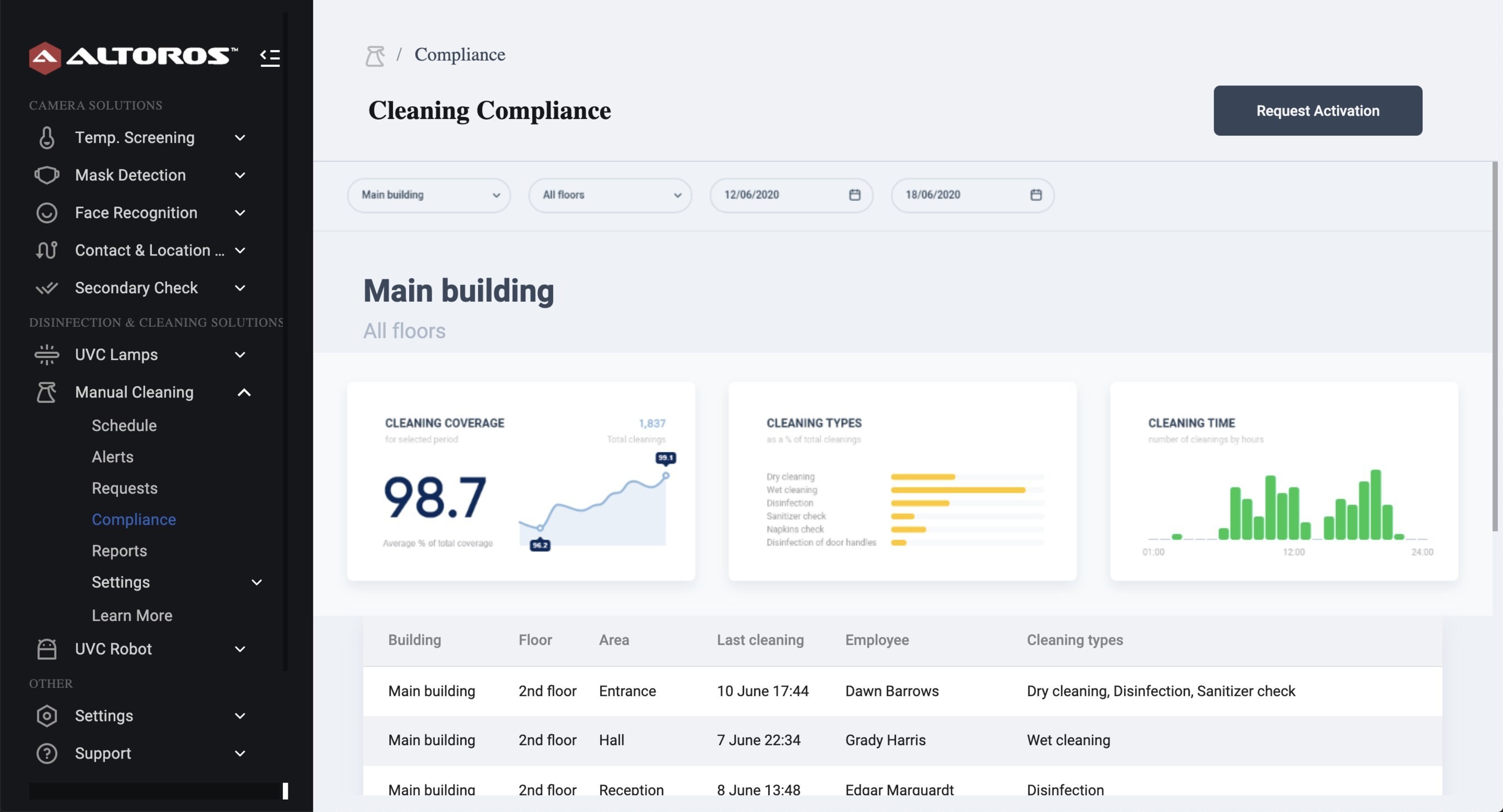
Metric Without Regulatory Context
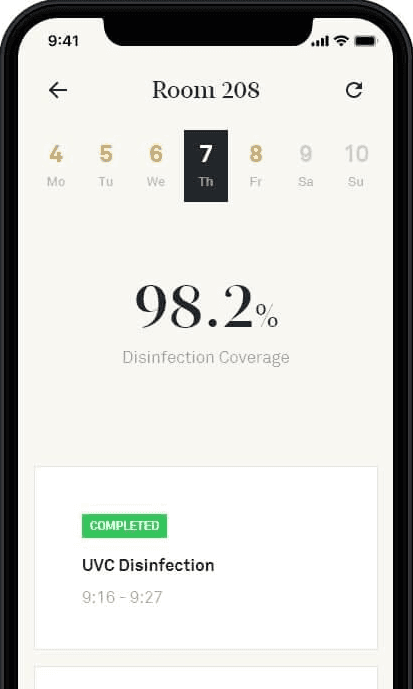
The prominent 98.7% "Cleaning Coverage" score was meaningless in a compliance context. A facility manager cannot tell an inspector "we're at 98.7%" without citing which regulation it's measured against. The metric tracked operational coverage, not regulatory adherence.
Activity Tracking ≠ Compliance Tracking
The dashboard tracked cleaning activity (what was cleaned, when, by whom) but said nothing about compliance status (which regulations are being met). These are fundamentally different mental models — one is retrospective operational data, the other is forward-looking risk management.
No Regulatory Mapping
There was no way to see which specific compliance requirements — CDC surface disinfection guidelines, OSHA workplace safety standards, state-level health codes — were being fulfilled by each cleaning activity. The data existed but the connection was invisible.
Flat Data Hierarchy
The cleaning log treated all activities equally. There was no visual or structural distinction between mandatory regulatory cleanings and optional maintenance tasks — making it impossible to quickly assess compliance risk.
Reactive Instead of Proactive
The dashboard only showed what had already happened. It offered no guidance on what needed to happen next to maintain compliance — no upcoming deadlines, no gap alerts, no at-risk indicators. Facility managers were left to mentally track compliance cadences.
No Audit-Ready Output
The data format wasn't structured for regulatory inspections. An inspector needs to verify compliance by regulation, not by room or by employee. Generating a compliance report required manual data restructuring.
Missing Document Layer
Compliance requires more than activity records: certificates, staff training records, product safety data sheets, and signed checklists. None of these supporting documents were accessible from the compliance view — a critical gap for audit readiness.
DESIGN CHALLENGE
Compliance Is Not One Thing
Compliance is a multi-dimensional requirement.
Compliance is not static. It's a layered, shifting landscape that varies across multiple dimensions simultaneously: by industry (a cruise ship has different protocols than an office building), by geography (federal requirements differ from state-level, which differ from county-level), by facility type (a hospital wing vs. an outpatient clinic), and by regulatory body (OSHA, CDC, local health departments).
UX Challenge
Designing a compliance layer that could flex across all these dimensions without becoming overwhelming was the core UX challenge.
Adding to the difficulty: we had no existing users to interview.
The product hadn't achieved significant adoption yet. I needed to find potential users and learn from them simultaneously — conducting outreach to compliance officers while also researching the regulatory landscape and ideating design solutions.
Team Capacity Problem
This problem required working across three streams in parallel: finding and talking to compliance professionals, deeply researching industry-specific regulations, and generating design concepts informed by both. Our team didn't have resources for such extensive work.
APPROACH
Building Without a Blueprint
Without an established user base, without a UX Research budget, I had to conduct cold outreach to compliance officers. Here are the key findings:
Regulation-First Mental Model
Compliance officers think in terms of regulations, not rooms or employees. They need to answer: "Are we meeting CDC Guideline X?" — not "Was Room 21 cleaned today?"
One Task, Multiple Regulations
A single cleaning activity often satisfies requirements from multiple regulatory bodies simultaneously. The ability to map this many-to-many relationship was seen as critical.
Industry Templates Save Weeks
Setting up compliance tracking from scratch was a major barrier. Pre-configured templates for specific industries (hospitality, healthcare, transportation) would dramatically reduce time-to-value.
I mapped the research findings to the existing dashboard audit, looking for the intersections where user mental models diverged most sharply from the current UI. Three design principles emerged: organize by regulation not by room, make the many-to-many task-regulation relationship visible, and dramatically reduce setup time through industry templates. These three principles became the brief for the design explorations.
DESIGN EXPLORATIONS
Rethinking the Compliance Layer
Compliance officers think in terms of regulations, not rooms — so the Compliance Hub organizes everything by regulatory framework rather than by physical space.
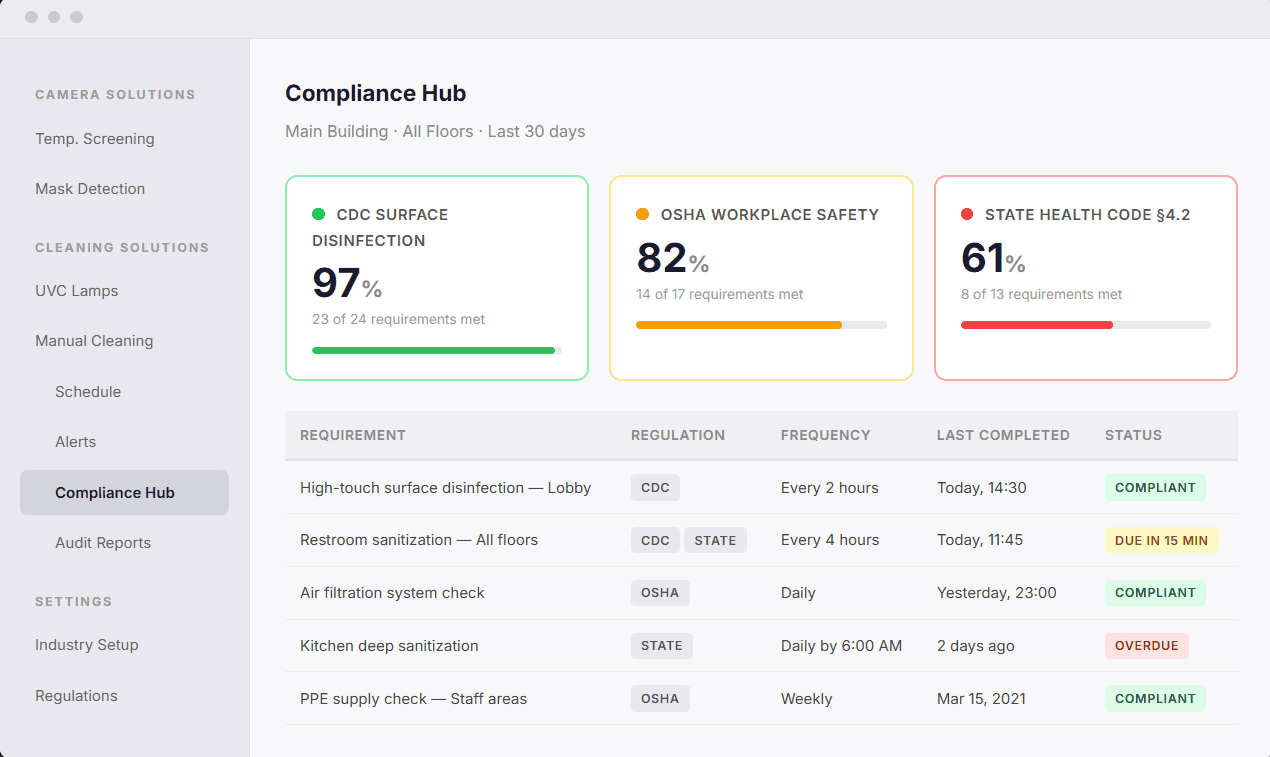
The Compliance Hub replaces the single aggregate score with regulation-specific cards. Each card maps directly to a regulatory framework, showing progress toward full compliance. The task table below connects individual cleaning activities to the regulations they satisfy.
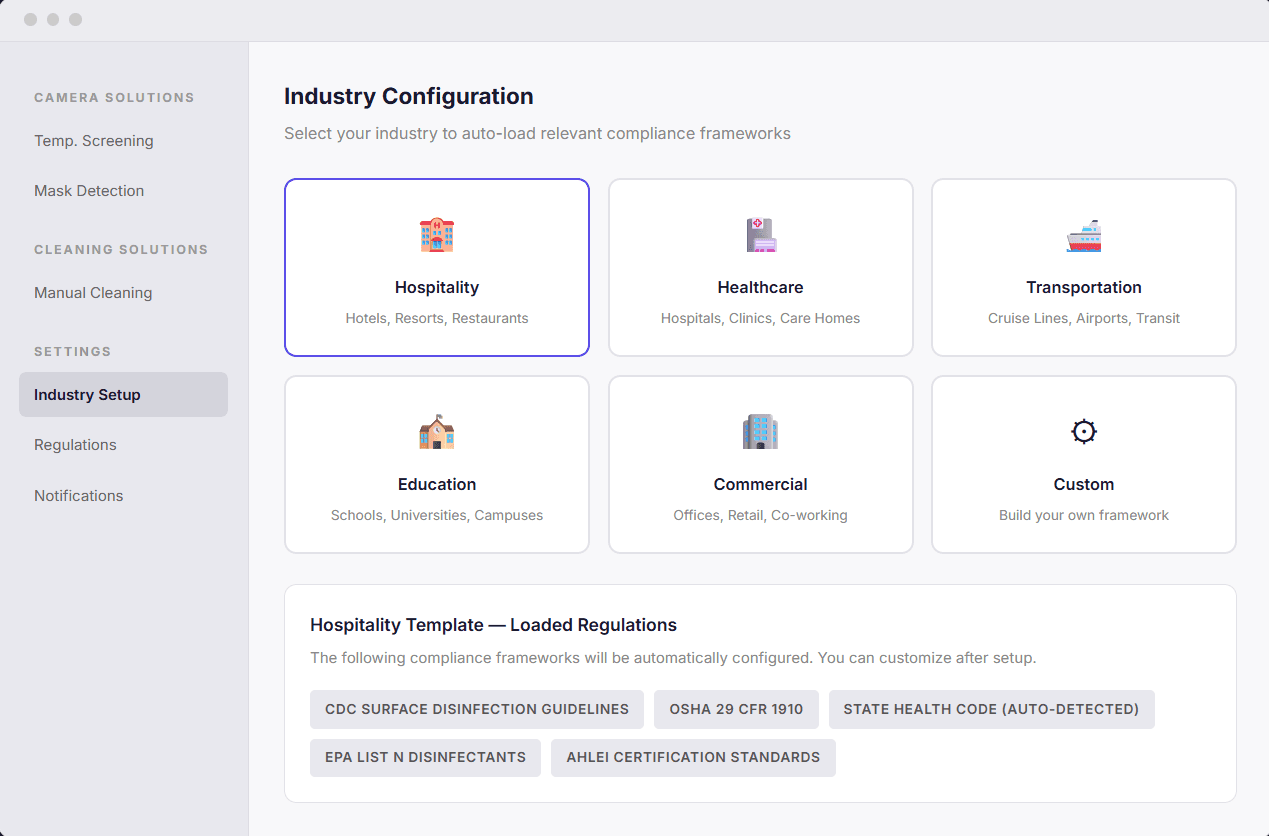
The Industry Configuration screen solves the "compliance varies everywhere" problem through templates. Rather than requiring facility managers to manually identify and configure every applicable regulation, they select their industry and the system auto-loads the relevant compliance frameworks — dramatically reducing setup time and cognitive load.
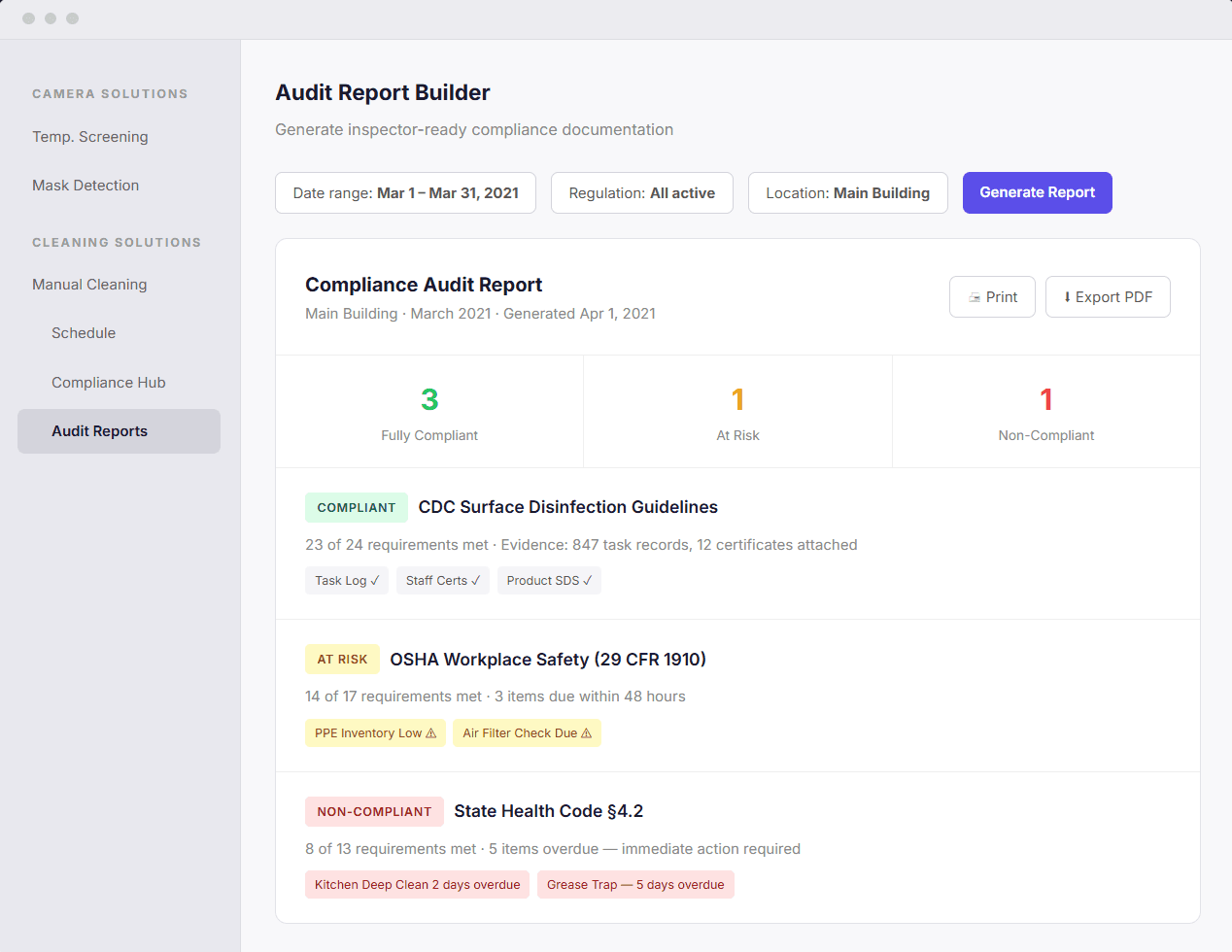
The Audit Report Builder addresses the most acute pain point: producing compliance documentation on short notice during inspections. The report is organized by regulation (matching how inspectors think), includes evidence chains, and highlights gaps with specific remediation urgency.
PROPOSED DESIGN
The Compliance-First Experience
Key design decisions: The compliance hub organizes information by regulation rather than by room — matching how facility managers think during inspections.
The new design shifts the mental model from "what cleaning happened" to "are we meeting our regulatory obligations."
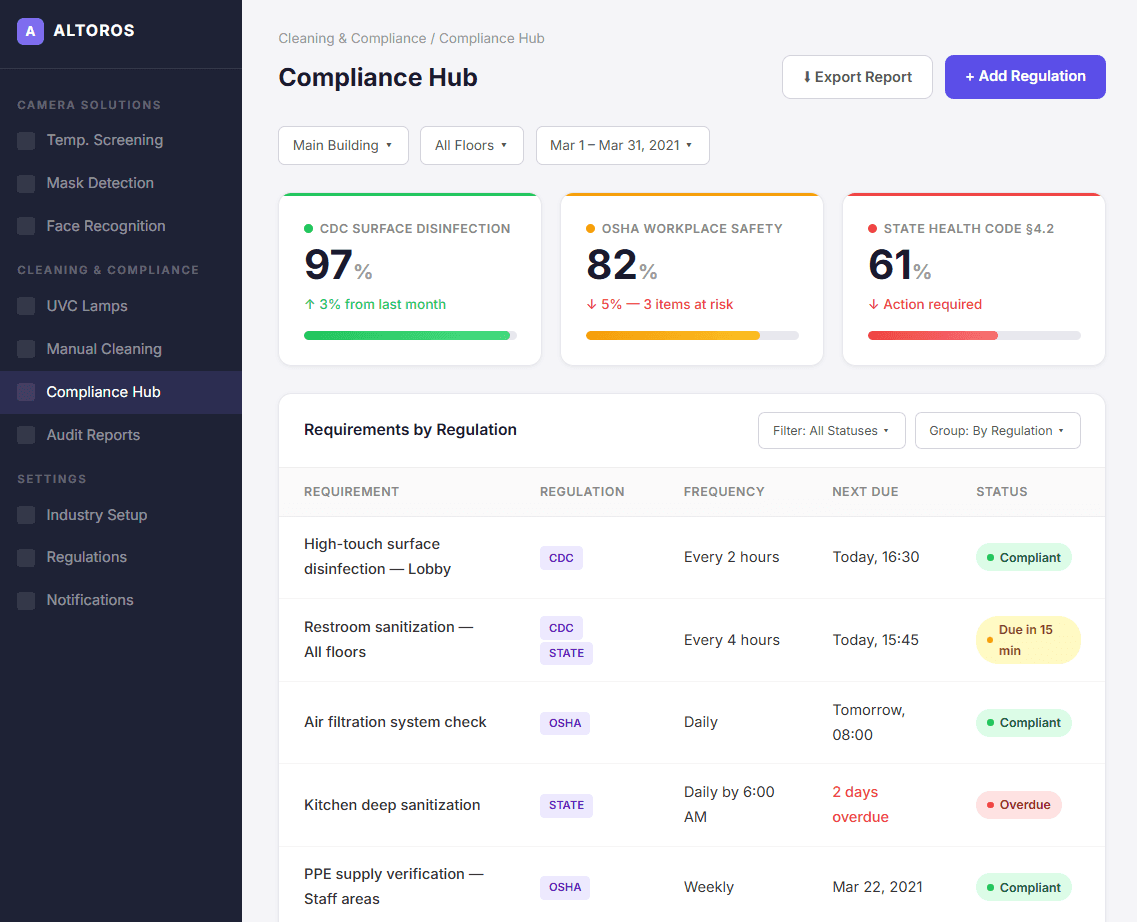
Red status cards leverage loss aversion — the cognitive tendency to weight potential losses more heavily than equivalent gains. A facility manager seeing red acts faster than one seeing amber.
WHAT HAPPENED IN THE MEANTIME
Major Product Strategy Miscalculation
As my compliance research progressed, a parallel pattern was emerging in the market that ultimately proved more decisive than any UX improvement.
Alarta had targeted the industries that suffered most visibly during COVID — hospitality, tourism, education, sports venues. These were also the industries that had closed entirely, survived on emergency support, and had no budget for new software subscriptions regardless of how well it solved their compliance problem.
The industries that never stopped operating — warehousing, logistics, essential retail, healthcare infrastructure — had urgent safety compliance needs and existing technology budgets. But they had been overlooked in the initial market positioning, and by the time the team considered pivoting, comparable solutions had already established themselves in those spaces.
Vaccination uptake then began compressing the window of urgency that made the entire product category viable. Compliance pressure that had been existential in early 2021 had become routine by late 2021.
I presented the combined findings — the compliance feature gap, the market segmentation problem, and the shrinking urgency window — to leadership. The recommendation was to discontinue the product rather than invest further in a market that had structurally changed.
What I'd do differently: I would have run the market segmentation analysis concurrently with the user research rather than sequentially. The industries-that-closed versus industries-that-kept-running distinction was visible in early conversations — I should have flagged it as a strategic risk earlier rather than treating it as context.